The Ferrari California is a car with the track in its DNA. It is enormously innovative and will more than fulfil the expectations of even our most discerning clients, offering breathtaking driving pleasure and fun behind the wheel as well as extreme versatility of use and in-car comfort.
In line with Ferrari tradition, this model positively brims with innovative features. In addition to its retractable hard top and the aforementioned original 2+ concept, the new Prancing Horse car also offers: a new direct injection V8 engine, a 7-speed gearbox with steering wheel-mounted F1-style paddles coupled with a new dual clutch, a new suspension system (double wishbones at the front and multilink at the rear), the new evolved F1-Trac traction control system and Brembo brakes with CCM (carbon ceramic material) discs as standard (this latter feature is shared by the other models in the current range).
Styling
The California's sleek aerodynamic styling is, like the rest of the current Ferrari models, the result of our longstanding collaboration with Pininfarina and offers a host of signature Ferrari styling cues. Viewed from the side, the aerodynamic sweep of the bonnet beautifully contrasts with the compact tail volume and the pulled-back cabin.
The front continues some of the themes hinted at on the flanks, harmoniously alternating concave and convex volumes. Seen head-on, the car clearly takes it much of its inspiration from the prestigious Prancing Horse car from which it takes its name: the grille and slender air intake at the centre of the bonnet most notably harking back to the 250 GT California. At the rear, the sides and the muscular tail section are both familiar too. As at the front, the single round LED taillights are inset directly along the edge of the boot. The California's vertically stacked twin tailpipes are an original flourish as is the boot which sweeps right down to the bumpers to improve functionality.
Of course, the interior also reflects the same level of design sophistication, exuding a sense of refined luxury, comfort and bespoke quality. Situated between the front seats, the new aluminium-trimmed centre console is another distinctive touch that goes beyond the merely aesthetic, beautifully combining functionality and design.
The Aerodynamics
The Ferrari California's aerodynamics were, of course, developed in tandem with its styling. This allowed Ferrari to keep the Cx (drag coefficient) right down with respect to the downforce required for optimal vehicle dynamics. In the coupé configuration, the Ferrari California has a Cx value of 0.32. A desire to achieve perfect balance between vertical load and drag influenced the shape of the rear diffuser and the spoiler incorporated into the front bumper. Drag has been cut to 10% lower than on the other Ferrari models which not only makes the Ferrari California a more aerodynamically efficient car but also reduces fuel consumption. Last but not least, the air intake on the bonnet ensures highly efficient cooling of the engine compartment.
The new 8-cylinder engine
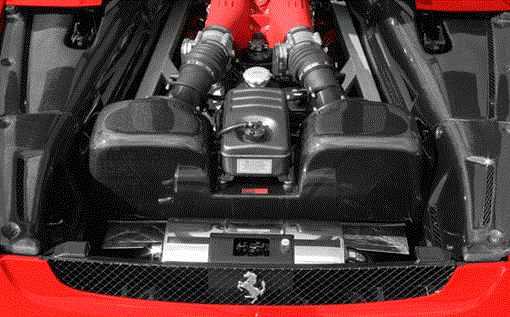
This is the first V8 in the history of Ferrari road-cars to be mid-front mounted. Built entirely from aluminium, it retains the typical Ferrari architecture with a 90° angle between the two cylinder banks and a 180° angle between the cranks.
The engine has a total displacement of 4,300 cc and a maximum power output of 460 hp/338 kW at 7,750 rpm. With a specific power of 107 hp/litre, its maximum torque is 485 Nm (49 kgm) at 5,000 rpm, 75% of which is available at just 2,250 rpm. The Ferrari California takes less than 4 seconds to accelerate from 0 to 100 km/h and delivers a blistering 310 km/h top speed.
The new V8 features direct fuel injection and variable timing (on both intake and exhaust) to guarantee superb performance, exceptional handling and fuel consumption and emissions that easily comply with the toughest Euro 5 and Lev2 standards. Thanks in part to these solutions, the Ferrari California consumes just 13.1 litres/100 km (ECE combined) and has carbon emissions of 305.6 g\km (ECE combined).
The Gearbox and transmission
The Ferrari California sports a new dual clutch gearbox (7-speed + reverse) with the now traditional steering wheel-mounted F1-style paddles. This is an innovative system that guarantees a superb combination of performance and ride comfort. With the dual clutch, one clutch is used for even-numbered gears and the other for odd-numbered ones, and allows the pre-selection of the next gear required.The gears are changed by overlapping the opening and closing stage of both clutches, resulting in gearshifting times that are close to zero and with no "torque interrupt". The result is not only enhanced performance but truly thrilling driving pleasure. The traditional transaxle layout (engine to the front and gearbox to the rear) also contributes to the California's perfect weight distribution (47% front - 53% rear) and to reducing vibration to the bodyshell. In manual mode, the new gearbox guarantees great sporty driving pleasure while extra comfort is assured in automatic.
The Chassis and suspensions
The Ferrari California's chassis and bodyshell are both made entirely from aluminium. Thanks to the use of different aluminium technologies (extrusions and shell casts), the car's exceptional versatility, onboard comfort and driveability has not added to chassis weight or to the dimensions of the structural sections - something that simply would not be the case had traditional steel architecture and technologies been used. Furthermore, static rigidity (torsional and flexional) has been improved with respect to average figures for a Spider to ensure exceptional handling in any kind of road conditions and to guarantee GT-standard comfort both with the top up and down.
The Ferrari California retains the traditional double wishbone suspension to the front while a new multilink system has been specially developed for the rear. The multilink system improves longitudinal flexibility of the suspension, keeping transverse rigidity values high. What this means in practice is that the car beautifully absorbs any unevenness, and noise and vibration are efficiently damped for exceptional ride comfort well on a par with the car's nimble handling. The SCM Magnetorheological Suspension Control System, debuted on the Ferrari 599 GTB Fiorano, is also available on request.
Retractable Hard Top
It is made from aluminium panels and has a cast aluminium weight-bearing structure which has reduced its overall weight and the moving masses involved. The entire opening/closing cycle is completed in just 14 seconds and thanks to the original stowage system, the California's boot space remains extremely generous regardless of whether it is up or down.
The GT Manettino and F1-Trac
The manettino has now become one of the classic features of our entire range as has its position on the steering wheel which is clearly derived from our Formula 1 experience. The manettino integrates the gearbox, stability and traction control systems (CST and F1-Trac) and the SCM suspension system.
The settings are as follows:
* COMFORT: maximum safety in all conditions, particularly ideal for low grip situations (wet or slippery road surface). Best everyday driving setting.
* SPORT: maximum performance and stability in perfect grip situations. Recommended for sporty, high performance driving.
* CST-OFF: this setting gives the driver complete freedom and control of the car. There is no electronic intervention whatsoever apart from ABS.
The Ferrari California also sports the F1-Trac traction control system which can very accurately read grip, assuring the very best can be made of the car's potential at any time.
The F1-Trac system guarantees:
* Maximum grip coming out of corners
* Stability in all driving conditions
* Superb driveability and handling in extreme situations
* Consistent performance
* Exceptional ride comfort.
Safety equipment
The Ferrari California boasts an ejectable roll-bar to ensure that its occupants are protected should the car overturn. The system is installed behind the backrests of the rear seats and is hidden by the trim of the same. Ejection time is under 190ms. The onboard safety equipment is completed by front retractable airbags (driver and passenger sides), side retractable air bags in door panels, bi-xenon headlights and LED rear lights. New generation adaptive headlights, known as AFS (Advanced Frontlighting System), are also available on request, and offer improved visibility on the road. The headlamp beam angles are automatically adjusted in line with steering, angle, speed and lateral acceleration, offering a wider area of illumination when cornering.
Interior and standard equipment
Particular attention has been lavished on the design and in-car comfort standard of the California's cabin. The new Ferrari is available in a choice of two configurations:
1. Two-seater plus rear bench equipped to take two roller suitcases or two golf bags.
2. 2+ configuration that sees the rear bench sporting two seats, Isofix attachment points, and two seat belts.
The boot capacity is also impressively generous: 340 litres with the top up and 240 with the top down.
A new electrically adjustable, magnesium-framed seat was also designed for the Ferrari California. Another new feature is the instrument panel with analogue instruments (tachometer and rev counter) and four-screen TFT Multidisplay. The Ferrari California also boasts a new infotainment system with 6.5'' touchscreen, Sat Nav, USB connection, Bluetooth, hard disc, voice commands and IPOD connector.
Samples of the various materials and virtual configuration tools will also be available to clients at every Ferrari showroom to help them make their choices too. They may also request outof- range colours and content to really ensure their Ferrari California is absolutely unique.
FERRARI CALIFORNIA TECHNICAL SPECIFICATIONS
 2011 Ferrari 458 Challenge Photos
 2011 Ferrari 458 Details


 Ferrari 599 GTB Wallpaper
 Ferrari 599 GTB best car wallpaper
 Ferrari 599 GTB
  Ferrari 612 Scaglietti Best Car Wallpaper
 Ferrari 612 Scaglietti picture




 The Ferrari 599 GTB Fiorano set a new standard in terms of performance that remains a benchmark for new sports car development to this day. Now Ferrari is introducing the new Ferrari 599 GTB Fiorano HGTE (Handling Gran Turismo Evoluzione) package for the model to further underscore its sportiness and handling.


 Ferrari 599XX, while based on the Ferrari 599 GTB Fiorano with the same transaxle layout and engine type, is an extreme track car. Ferrari's engineers have carried out extensive work on the engine's combustion chambers and inlet and exhaust tracts. These modifications, combined with the fact that internal attrition has been reduced and the maximum revs have been boosted to 9,000 rpm, helped achieve the target power output of 700 hp at 9,000 rpm. Particular attention was also paid to cutting the weight of the engine unit components. This was achieved both by optimising forms - as in the new crankshaft - and adopting exclusive materials, as in the carbon-fibre used for the intake plenums. A new gearbox shift strategy cuts overall gearchange times to 60 ms.


 The Ferrari California is an exceptionally innovative car whose philosophy takes its inspiration from the spirit and emotions of one of the great Ferraris of the past, the 1957 250 California, a superbly elegant open top car designed for the track, which has, over the years, come to symbolise not only superior sportiness and performance but also exclusivity, craftsmanship and faultless sophistication.


