


Showing posts with label Concept Car. Show all posts
Showing posts with label Concept Car. Show all posts

Renault Electric Sports Car DeZir Concept
The Renault DeZir project is the first to have been led by Laurens van den Acker and marks the start of a sequence of concept cars that will provide an insight into Renault Design's new vision for the future. DeZir stands out as an illustration of the brand's commitment to more emotional styling.
The DeZir is a two-seater coupé that Renault says stands out as an illustration of the company’s commitment to more emotional styling. With its sports car looks and ability to accelerate from 0 to 100 km/h (62mph) in five seconds, or 0 to 50 km/h in just two seconds, it’s hard to disagree.

Although the DeZir is purely a concept car at this point, Renault is strongly hinting that it shows not only the direction they plan on heading with sports cars in the future, but that it is indicative of a new overarching design and styling philosophy across the entire Renault brand.
The 'Z' in the name Renault DeZir is a direct reference to Renault's Z.E. signature, and several features of its design are suggestive of two qualities readily associated with electric mobility, namely advanced technology and light weight.

DeZir is powered by an electric motor mounted in a mid-rear position to optimize weight distribution over the front and rear wheels. The vertically-mounted 24kW/h lithium-ion battery is located behind the benchseat and provides the car with a range of 160km.
Battery cooling is ensured not only by the air channelled from the front to the back of the car, but also – and above all – by the flow of air that enters through the lateral scoops concealed behind the aluminium panels on either side of the body.

Employing the same principles as the KERS (Kinetic Energy Recovery System) seen in Formula 1, when the car decelerates, kinetic energy is recovered and stored in the battery. This energy can then be employed by the driver to provide a temporary power boost using a button located on the steering wheel. The car can be charged in 8 hours at 240-v, can get to 80% charge in 20 minutes at 4o0-v (3-phase) and will accept battery swapping made possible by the Better Place alliance.

The basic motor is the same as the unit used for Renault's production electric cars, although an evolution has enabled its power and torque to be uprated to 110kW (150ch) and 226Nm respectively. Through the extensive use of lightweight materials such as the Kevlar body, the DeZir tips the scales at just 830kg or 1,830 pounds. According to the French carmaker, the DeZir can go from zero to 100km/h (62mph) in 5 seconds and reach a top speed of 180km/h or 112mph.

The DeZir will debut in October at this year's Paris Motor Show, but no date has been set for its full release. According to Fast Company, by the end of 2013 the Renault-Nissan alliance hopes to produce 500,000 electric vehicles globally, including the 2011 Fluence ZE and the 2011 Kangoo ZE electric van.

Labels: Concept Car, Renault, Sports Car

Paying his tribute to the SAAB Spyker Automobiles, Swedish designer Eduard Gray has come up with a vehicle concept called the “SAAB Spyker 9+ Tribute” that is not only pleasant to watch but to drive as well. Combining the elements of a mid-engined SAAB with the Spyker platform, the new supercar featuring low down aerodynamics will possibly generate power from an Audi-sourced V8 engine. Touting a big windshield that extends to complete the roof, the Saab Spyker 9+ Tribute allows a wider view to the commuters. His long, lean two-door Saab Spyker 9+ concept car imagines an evolution of Saab's Aero-X enhanced by some of Spyker's exoticism.

2010 SAAB Spyker 9+ Tribute
The ink is barely dry on Dutch supercar marque Spyker’s deal to buy Saab, but speculation as to what sort of alluring automotive offspring might arise from the union has already begun. Eduard Gray, an industrial designer educated at Coventry University in the UK and now based in Trollhättan, Sweden, has come up with a concrete vision.

2010 SAAB Spyker 9+ Tribute
The union of Saab and Spyker presents a unique opportunity to create a design that takes the best of each brand and distills their qualities into a single product," he said. Gray, who is Dutch and English, points out that a truly unique car can be assembled with the low-slung mid-engine Spyker supercar chassis and the design language at Saab. Spyker lends us its supercar chassis with a mid-mounted engine and low down aerodynamics while Saab contributes with the style, character and engineering making for a design that is as pleasant to look at as it is to drive.

2010 SAAB Spyker 9+ Tribute
Indeed, his six drawings of the Saab Spyker 9+ Tribute shows elements of both companies. Gray calls the work "a quick expression of my optimism for the future of the brand."

2010 SAAB Spyker 9+ Tribute
The distinctly Scandinavian design features a Spyker chassis with a mid-mounted engine and low down aerodynamics, including a system to reduce friction in straight line driving whilst increasing traction in cornering and braking. An enormous panoramic glass roof gives it something of a targa feel as well. Envisioned as a 2+2 model in the storied GT tradition, engine-wise it’s speculated to house a V6 bi-turbo capable of producing over 600 hp, perhaps powered purely by ethanol – we’re talking about the future after all.
Labels: 2010, Concept Car, Sports Car, Super Cars

Chevron Racing Cars is exhibiting the new Chevron GR8 in prototype chassis form at Autosport International. The new mid-engined competition coupe with Cosworth YD 2.0 litre power is being built for the one-make Chevron GR8 Challenge Series. UK-based specialist race car construction company Chevron have revealed the production specifications and images of their latest vehicle, the GR8. The GR8, which is the company's first all-new coupe for forty years, uses some of the design cues from Chevron's previous B8 coupe model. Although for the new car the bodywork has been made considerably sharper and more contemporary.

2010 Chevron Racing Cars GR8 Cosworth
Organised by the British Automobile Racing Club (BARC), the Series will make its racing debut at Silverstone on 8/9 May 2010. Two Series rounds are to be staged at each of seven BARC race meetings. An additional round is a possibility if racing is resumed at Donington Park.

2010 Chevron Racing Cars GR8 Cosworth
The final decision by Cheshire-based Chevron to exhibit at Autosport International was not taken until last week as the finishing touches were being put to the prototype chassis. The body is being shown in the form of design renderings generated from the CAD files produced for machining the body tooling model. Commencement of testing, initially without bodywork, is imminent.

2010 Chevron Racing Cars GR8 Cosworth
The GR8 concept rendering, which Chevron confirms is fairly close to the final design, reveals a discernable relationship to its illustrious predecessor, the Chevron B8, an enduring favourite with historic sporstcar competitors. Fabrication of the GR8 prototype is in progress and development testing is scheduled to commence in January.

2010 Chevron Racing Cars GR8 Cosworth
The design of the new car has a deliberate affinity with the classic Chevron B8 racing coupe, some 70 of which were built following its introduction in 1968. Priced £3,380 new, Chevron B8s - which typically make up a significant percentage of grids in international championship historic sports and GT racing - now change hands for £300,000.

2010 Chevron Racing Cars GR8 Cosworth
The body is the work of international automotive design consultant Lester Allen, an ex-GM studio chief designer and former senior Royal College of Art vehicle design course tutor. Most of Lester Allen's work in recent years has been behind the scenes for Asian manufacturers. Previous British car designs for which he has been responsible include the Bentley Continental R and Aston Martin Virage, both for the one-time Heffernan Greenley consultancy.

2010 Chevron Racing Cars GR8 Cosworth
Provision has been made in the bodywork design for window lifts and other refinements suited to customers who may wish to have a road-going car conforming to Low Volume Type Approval legislation.The Cosworth 2.0L YD in-line 4-cylinder power unit develops 255-260 bhp at 8200 rpm. Peak torque is 190 ft-lbs at 7500 rpm. Engines for the Chevron GR8 are being built alongside Cosworth's F1 production line.

2010 Chevron Racing Cars GR8 Cosworth
The Chevron installation features a PiRQ4 engine control unit incorporating technologies derived from ECUs used by winners of the FIA GT and World Rally Championship titles. The Cosworth electronics package includes a Pi Omega LCD panel display, providing crystal-clear readouts for the driver and seamless integration with the engine control unit data.

2010 Chevron Racing Cars GR8 Cosworth
The Chevron GR8 is constructed around a centre section comprising a semi-monocoque aluminium sills and platform structure integrated with an MSA compliant roll cage in 50 mm diameter steel tube. Forward of the front bulkhead, a 50 mm and 25 mm box section steel spaceframe incorporates a removable nose box. The rear spaceframe is also in 50 mm and 25 mm box section steel. The sills make more effective use of material than might be the case with a tubular structure and are seen as a better solution to side impact protection. The braking system uses AP callipers, with 330 mm diameter by 28 mm wide discs at the front and 304 mm diameter by 28 mm discs at the rear. Steering is rack and pinion. All aeroquip is by Goodridge.

2010 Chevron Racing Cars GR8 Cosworth
Two Chevron GR8 Challenge Series rounds will be run at each of the BARC meetings where the Series is in the programme and races will feature rolling starts. Entries are open to either one or two drivers. With a team of two, the idea is for each to contest one round. Accepting entries for two drivers creates obvious opportunities for sharing costs. As part of the support provided to participants, Chevron plans to have a pool car on hand as a spare should a competitor's own Chevron GR8 be unable to start a race for whatever reason.

2010 Chevron Racing Cars GR8 Cosworth
The Chevron GR8 model name has aroused a certain amount of internet chatter. Chevron Racing's Helen Bashford-Malkie comments: "In the wake of the announcement late last year that the Chevron GR8 project was under way, I guess the name was up for discussion amongst blogging community for the reason that few hard details had been released about the car.
"The inclusion of '8' pays homage to the B8, the project's inspiration. 'GR' stands for Grand Touring/Racing, but as GTR is used for a Nissan model, we omitted 'T'. We elected for 'GR' because it's got a bit of 'grrrr' combativeness about it. If some people choose to interpret 'GR8' as texting for great well, okay. The fact that it is also being used in the name of the racing Series was also a consideration."
Labels: 2010, Concept Car, Racing Car, Sports Car

Hennessey Performance Engineering today announced that it is introducing the company's first concept car - The Venom GT. Penned by British auto designer, Steve Everitt, the Venom GT would incorporate Hennessey's potent Venom 1000 Twin Turbo Viper V10 powerplant into a light weight mid-engine chassis weighing "under 2,700 lbs". Power would be run through a 6-speed transmission or optional sequential gearbox. With a power to weight ratio of just 2.7 lbs per bhp Hennessey estimates that the Venom GT could attain 0 to 100 km/h times in less than 2.5 sec. and a 0-300 km/h time of around 14 seconds.

Venom GT Hennessey Supercar
The Hennessey Venom GT weights less than 2,400 lbs (1,071 Kg) and to stop the Venom GT, Hennessey added Brembo brakes with 6-piston calipers up front and 4-piston calipers in rear clamping down on 15-inch carbon ceramic rotors. Hennessey plans on building 10 units of the Venom GT annually and four have already been sold at around $600,000 a pop. That means there are only six units left from the first allocation.

Venom GT Hennessey Supercar
SEALY, TEXAS & SILVERSTONE, ENGLAND, March 29, 2010 - Hennessey Performance is pleased to introduce the first official images of its Venom GT supercar. Based upon the Lotus Elise, the Venom GT combines a high-tech, lightweight British chassis with a powerful American V8.

Venom GT Hennessey Supercar
“This is not the first time that Britain and America have joined forces to produce a weapon of mass propulsion”, said company founder and president, John Hennessey. “Over fifty years ago the American-built P-51 Mustang fighter aircraft was flown into history powered by a British Rolls-Royce Merlin engine. Today the Hennessey Venom GT promises to set a new standard of power to weight ratio in the rarefied air of today's supercar market.”

Venom GT Hennessey Supercar
In the case of the Venom GT, less weight means more performance. The Venom GT will have a production curb weight of less than 2,400 lbs (1,071 kilos) aided by its lightweight carbon fiber bodywork and carbon fiber wheels. Stopping power is delivered via Brembo brakes with 6-piston calipers up front and 4-piston calipers in rear clamping down on 15-inch carbon ceramic rotors.

Venom GT Hennessey Supercar
The Venom GT’s base power plant is the supercharged 6.2 liter LS9 V8 (the same as in the Corvette ZR1) tweaked by Hennessey to 725 bhp. The company will also be offering 1000 bhp and 1200 bhp twin turbo V8 engine variants. The mid-engine V8 will transmit its power to the rear tires via a Ricardo 6-speed gearbox.

Venom GT Hennessey Supercar
Hennessey plans to manage power output by using a programmable traction control system. CFD (computational fluid dynamic) tested bodywork and down force will also help keep the Venom stable at speed. An active aero system with adjustable rear wing will deploy under varying conditions on both the road and racetrack. An adjustable suspension system will allow ride height adjustments according to speed and driving conditions. Finally, power will be put to the ground via massive Michelin PS2 tires.

Venom GT Hennessey Supercar
Hennessey will be building the power plants at its Texas facility. The engines will then be air freighted to the company's assembly facility near Silverstone, England where the Venom GT is built and tested. Venom GT buyer will be offered a 1-day driver orientation and instruction program by a Hennessey factory test driver, at a track in the UK or USA prior to delivery.

Venom GT Hennessey Supercar
Hennessey plans on building 10 units of the Venom GT annually and four have already been sold at around $600,000 a pop. That means there are only six units left from the first allocation. The company plans to establish a network of Venom GT dealers and distributors in the Middle East, Europe, Russia, Australia and Asia.
Labels: 2010, Concept Car, Sports Car, Supercars

CITROËN is proposing a new automotive vision with Survolt. Initiated by the Revolte concept car revealed at last year’s Frankfurt Motor Show, Survolt is the continuation of CITROËN’S exploration of distinctive and original electric vehicles. Survolt Concept turns received notions through its radically new vision in a consummate blend of high-fashion glamour and motor-racing extravagance.


2010 Citroen Survolt Concept
Citroen makes a car a typical electric vehicle to answer the wishes of the customer to overcome one’s limits, take things further and dare. It takes the genetic material of Revolte and adds an extroverted sports dimension to the mix. The Citroen Survolt Concept has been declared at the Frankfurt Motor Show.


2010 Citroen Survolt Concept
Citroen Survolt Concept is powered by electricity, thus combining sports performance with environmental respect and sustainable development. Still particularly rare in the racing world, this technological solution also embodies a previously unthinkable alliance. But Citroen dares and creates, transgressing conventions to better sublimate them. With irreproachable ecological credentials, the drivetrain blends driving pleasure, thrills, performance and vitality, and all in extreme comfort, since the car is silent in operation.


2010 Citroen Survolt Concept
Survolt features two-tone paint, hues of fuchsia and charcoal grey, and plays with materials and volumes. It is further characterized by the strong contrasts between the voluptuous bonnet and and sculpted flanks with emphatic wheel arches. At the front, the distinctive Citroen badge reigns above the large oval-shaped grille, while its slim and horizontal head lamps are inspired by sports coupés. At the rear, Survolt features the elegant light signature of Revolte together with a spoiler in an essential reference to motor sport. Inside, Survolt’s cockpit is designed like a floating cell with a glass setting held between chrome-finished roll bars.

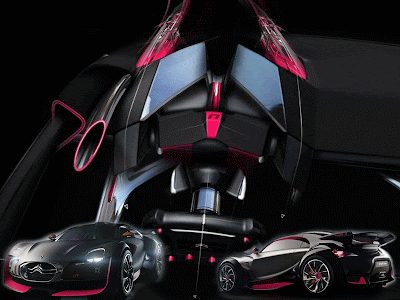
2010 Citroen Survolt Concept
Citroen Survolt Concept activated by electric drivetrain and equipped with luxury accessories. It’s has compact dimensions – 3.85 m long, 1.87 m wide and 1.20 m high so the display is sporty and elegant style supermini. At the front, the distinctive vehicle badge reigns elegantly above the large oval-shaped grille, its centre home to the striking double chevron. The body is slim, horizontal head lamps, inspired by high-performance sports coupés, exert a magnetic appeal, while an LED light signature adds a contemporary, high-tech touch.

2010 Citroen Survolt Concept
Labels: 2010, Citroën, Concept Car, Sports Car


2010 Lotus Evora Carbon Concept
The head turning looks of the Evora Carbon Concept car provide a more purposeful, planted stance with the car looking lower and more aggressive. This styling direction is continued with a structural carbon fibre roof, Lotus Motorsport influenced carbon diffuser and carbon splitter. The Evora Carbon Concept car retains the same class leading handling and high tech aluminium bonded and extruded chassis of the production car.

2010 Lotus Evora Carbon Concept
Donato Coco, Director of Lotus Design announced, “The design of the Evora Carbon Concept car features exotic, high tech materials offering a good synergy with the Lotus brand image, expressing our motor sport heritage and history of stylish sports cars due to which Lotus are renowned”.

2010 Lotus Evora Carbon Concept
Carbon fibre panels with perforated leather and Matt Alcantara are featured in the interior. For example, the dashboard, footwell and inner roof are covered in Alcantara, while exposed carbon fibre can be seen on the centre console, air vents and others. It sports a carbon fibre roof, 19-inch alloy wheels with 235/35 front and 285/30 rear Pirelli P-Zero Corsa tyres.

2010 Lotus Evora Carbon Concept
While no engine tweaks have been mentioned, the drop in weight means the Toyota-sourced 3.5-litre V6 has a lot less mass to move thus performance has been significantly boosted. Be on the look-out for a production version of the Evora Carbon Concept in the not-too-distant future.

2010 Lotus Evora Carbon Concept
Labels: 2010, Concept Car, Lotus, Sports Car

At the Swiss international auto show Audi has introduced its new A8 Hybrid. According to the producers, though the vehicle is designed as a concept of the gasoline-electric hybrid version, it is scheduled to enter the mass production next year. Audi revealed today the details of the upcoming A8 Hybrid Concept, set to make its official debut at the Geneva Motor Show.

2010 Audi A8 Hybrid Concept Car
Audi fits its largest sedan with a familiar 2.0-liter, turbocharged 4-cylinder engine and then mates it to a 45-horsepower electric motor for a combined 245 system horsepower. A lithium-ion battery pack is stored in the rear. According to Audi, this efficient flagship will accelerate to 60 mph in about 7.5 seconds and reach a top speed of 146 mph. Best of all, the 5-passenger full-size luxury sedan earns the equivalent of nearly 38 mpg on the EPA cycle.

2010 Audi A8 Hybrid Concept Car
Power like a big V6, fuel economy like a modest four-cylinder unit - Audi presents the Audi A8 Hybrid Concept as a technology concept at the 2010 Geneva Motor Show. Its two propulsion units - a 2.0 TFSI and an electric motor - develop a total output of 180 kW (245 hp) of system power and 480 Nm (354.03 lb-ft) of torque. This enables the Audi A8 Hybrid to accelerate in 7.6 seconds from zero to 100 km/h (62.14 mph) and to achieve a top speed of 235 km/h (146.02 mph). Yet its average fuel consumption amounts to only 6.2 liters (37.94 US mpg) per 100 km - the CO2 equivalent is 144 grams per km (231.75 g/mile).

2010 Audi A8 Hybrid Concept Car
The combustion engine of the Audi A8 Hybrid Concept is the 2.0 TFSI - a high-tech powerplant. This four-cylinder unit, which has been named "Engine of the Year" five times in a row since 2005, is an example of Audi's downsizing philosophy. It combines direct fuel injection with turbocharging and the AVS Audi valvelift system, which regulates the valve lift in two stages. In combination with the adjustable intake camshaft, the Audi valvelift system improves cylinder charging and ensures spontaneous and powerful torque build-up. The 2.0 TFSI delivers 155 kW (211 hp) and 350 Nm (258.15 lb-ft); the torque value remains constant from 1,500 to 4,200 rpm.

2010 Audi A8 Hybrid Concept Car
A hydraulically operated wet clutch links the 2.0 TFSI with the electric motor. Its control requires the utmost precision, and a great deal of know-how has been expended to achieve its smooth, precise and swift operation. The synchronous motor, which is continually excited, also serves as a generator that develops 33 kW (45 hp) of power and 211 Nm (155.63 lb-ft) of torque.

2010 Audi A8 Hybrid Concept Car
The energy storage system of the Audi A8 Hybrid Concept is mounted in the rear section. This state-of-the-art lithium-ion battery is more compact and weighs less than other types but is substantially more powerful. It is protected by a high-strength housing, and a ventilation module ensures that it always operated within the ideal temperature range. Yet the Audi A8 hybrid Concept also provides ample luggage space of 400 liters (14.13 cubic feet). Several subsystems that operate on engine power in a conventional car have been modified right from the start for use in the Audi A8 Hybrid Concept. The compressor in the climate control system runs entirely on electric power.

2010 Audi A8 Hybrid Concept Car
The power electronics unit manages the interaction of the systems. Its pulse control inverter regulates the interplay of the battery and the electric motor. The DC-DC converter supplies power to users on the onboard network. The power electronics unit, which is connected to the battery and the electric motor by high-voltage cables, is located in the engine compartment. The smooth interaction of these components and their high level of integration attest to the specialized know-how Audi has accumulated. The technology architecture already provides a glimpse of a future production model - the Audi Q5 hybrid, which will be introduced later this year.

2010 Audi A8 Hybrid Concept Car
The engine compartment cover with its high-gloss finish and the glass cover of the battery in the trunk also provide visual links to hybrid technology. And the illuminated doorsteps bear the "hybrid" insignia as an elegant touch to underscore the electric aspect whenever the doors are opened - using LED technology to minimize energy consumption.

2010 Audi A8 Hybrid Concept Car
The passengers also see the prominent hybrid logo displayed on the dashboard. Some of the most significant features of the hybrid vehicle include 21-inch, two-color alloy wheels, a special paint job and the so-called “Powermeter”.

2010 Audi A8 Hybrid Concept Car
Labels: 2010, Audi, Concept Car, Hybrid Car
Subscribe to:
Posts (Atom)


